

The whistle blows, the referee rolls both fists in front of their chest, and a player stands there holding the ball, genuinely unsure what just happened. Half the gym groans. The other half looks just as lost.
Basketball seems like the simplest game in the world until someone blows a whistle and nobody can explain why. Whether you’re picking up a ball for the first time, watching from the bleachers, or trying to make sense of a game on TV, these basketball rules for beginners cover how the game works, what gets called, and why the rules shift depending on who’s playing.

How a Basketball Game Works
Two teams of five share the court, each trying to put the ball through the basket its opponent defends. The team with the ball keeps it until it scores, loses it, or breaks a rule, and then the other team heads the other way.
Players move the ball in only two ways: dribbling it or passing it. Everything else in the game, from the simplest set play to a fast break, is built on those two actions.
Older players start a game with a jump ball at center court, where the referee tosses the ball up between one player from each team. In high school and college, later tie-ups are settled by an alternating possession arrow rather than another jump. Younger kids often skip the jump ball entirely and start with a coin flip.
How long the game lasts depends on the level.
How Scoring Works
A basket from inside the three-point arc is worth two points. From behind it, three, as long as the shooter’s feet aren’t touching the line. A toe on the line makes it a two. Free throws, awarded after certain fouls, are worth one point each, shot from a line 15 feet from the basket at most levels.
A player who’s fouled while making a shot gets the basket plus one free throw, the play everyone calls an “and-one.”
Free throws are the only uncontested shots in the game, which is why coaches treat them as something to rehearse, not just practice. Good shooters use the same routine every time: same number of dribbles, same breath, same release. When the gym is loud and the game is close, the routine is what holds.
The Same Game, Different Rules at Every Level
Much of the confusion around basketball rules comes from mixing levels without saying so. Here’s how the major American levels compare.
| High school | College | NBA | |
|---|---|---|---|
| Game length | Four 8-minute quarters | Men: two 20-minute halves. Women: four 10-minute quarters | Four 12-minute quarters |
| Three-point line | 19 ft 9 in | 22 ft 1¾ in | 23 ft 9 in (22 ft in the corners) |
| Shot clock | Varies by state | 30 seconds | 24 seconds |
| Fouls before fouling out | 5 | 5 | 6 |
The shot clock limits how long the offense can hold the ball before shooting. In high school, each state decides whether to use one. For a deeper look at how college and pro rules differ, see our breakdown of the two.
Violations: The Whistles That Don’t Involve Contact
A violation hands the ball to the other team. No free throws, no foul counted, just a turnover.
Traveling is the one every beginner meets first, and it’s worth understanding properly, because it’s a footwork problem far more often than an awareness problem. When you catch the ball standing still, one foot becomes your pivot foot. You can spin on it, step with the other foot as much as you like, and even lift the pivot to pass or shoot, as long as the ball is gone before that foot comes back down. What you can’t do is slide or shuffle it. To start dribbling, the ball has to leave your hand before the pivot foot lifts. For newer players, the trouble usually starts right on the catch, when their feet are moving before they’ve decided which one is planted. High school officials are paying particular attention this season, too: traveling and legal player movement are among the NFHS points of emphasis for 2026-27.
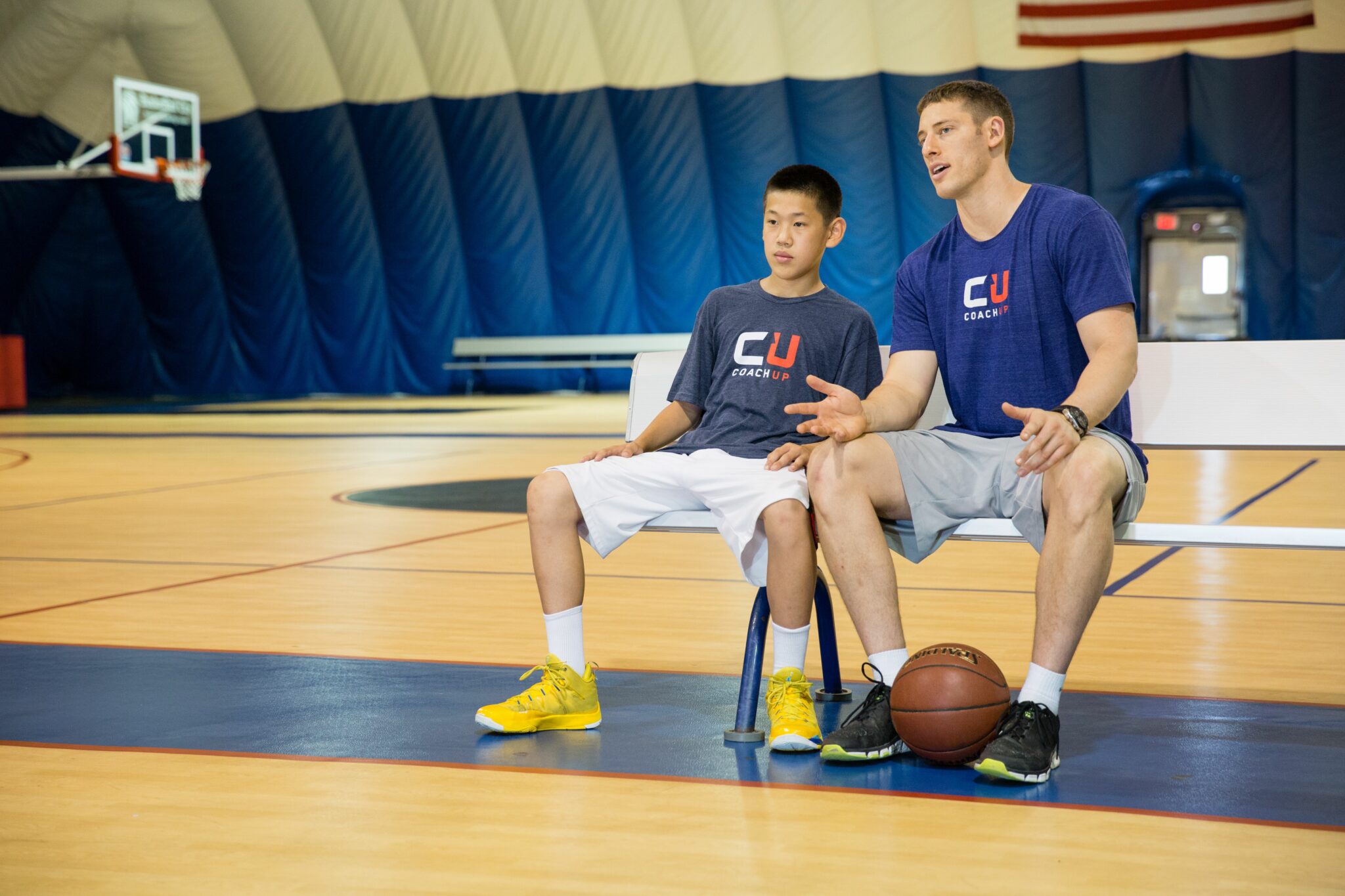
The fix isn’t thinking harder in the moment. It’s drilling catches and pivots until one foot plants automatically, which is exactly the kind of detail a private coach on CoachUp can watch rep by rep in a way a crowded team practice rarely allows.
Double dribble and carrying are ball-control violations. A double dribble is dribbling with both hands at once, or stopping your dribble and then starting again. Carrying happens when your hand slides under the ball and turns it over mid-dribble, usually because you’re trying to protect it or change direction too fast. Both tend to disappear as ball-handling improves and players stop needing to look at the ball.
A few others round out the list. An offensive player can’t stay in the painted lane near the basket for more than three seconds. Once a team brings the ball across half court, it can’t take it back into the backcourt. And it only has so long to get there: ten seconds in most high school and college games, eight in the NBA.
Fouls: When Contact Crosses the Line
Basketball allows plenty of contact. A foul is contact that creates an unfair advantage: hitting an arm, pushing for position, holding.
Most fouls simply give the other team the ball out of bounds. A shooting foul sends the shooter to the line: two free throws for a missed two-point attempt, three for a missed three, and one if the shot went in anyway.
The call fans argue about most is the block versus the charge, and it makes more sense once you know what the defender needs to do. To draw a charge, the defender has to establish position first, with both feet set and facing the ball handler, before the offensive player goes up. Arrive late, or keep sliding into the path, and it’s a blocking foul on the defense. College and the NBA also paint a small arc under the basket where defenders can’t draw a charge at all. High school courts don’t have one.
Technical fouls cover unsportsmanlike behavior and send the other team to the line. Flagrant fouls are for excessive or dangerous contact and can mean ejection.
Every foul also counts toward a team total. In high school, a team reaches the bonus on the opponent’s fifth foul of a quarter, which means two free throws on every foul after that, and team fouls reset each quarter. If you learned the game years ago, you may remember the one-and-one. It’s gone at the high school level.

Youth Basketball Plays by Different Rules
Watch a game of eight-year-olds and you’ll notice nobody’s shooting threes. That’s by design. The NBA and USA Basketball publish recommended rules that scale the game to kids as they grow.
For ages 7 and 8, that means a smaller size 5 ball, a basket lowered to 8 feet, free throws from 14 feet, and no three-pointers at all. Every player gets equal time, and defense is strictly player-to-player: no pressing, no double-teams, and no stealing the ball from a dribbler. From 9 to 11, the ball moves up to a size 6 and the basket rises to 9 feet, but threes still don’t count. Around 12, the full game arrives: a 10-foot basket, a 15-foot free throw line, the three-point arc, jump balls, zone defense, and a shot clock.
The logic is developmental. A kid heaving a full-size ball at a 10-foot rim learns to throw, not shoot, and those habits are hard to undo later. Player-to-player defense makes every child responsible for guarding someone instead of standing in a zone waiting for the ball.
These are national recommendations, not universal law. Plenty of gyms can’t lower their baskets, so your league’s own rulebook is the final word.
How to Follow a Game From the Stands
Referees talk with their hands. Rolling fists mean traveling, and a patting motion with the palms signals a double dribble. Three fingers held out sideways is a three-second call, and hands on the hips is a blocking foul. During a long shot, watch for one arm raised with three fingers up, which means a three-point attempt. Both arms go up if it falls.
At the scorer’s table in high school and college games, the possession arrow shows which team gets the ball on the next tie-up. And when a referee’s hand goes straight up and stays there, the clock is stopped until they chop it back down.
Basketball Terms Worth Knowing
- Box out: Using your body to seal an opponent away from the basket so you can grab a rebound.
- Screen: A legal block, set by an offensive player standing still, to free up a teammate.
- Turnover: Any lost possession without a shot, from a bad pass to a violation.
- The paint: The painted lane under each basket, where the three-second rule applies.
- Bonus: The point in a period when every team foul sends the opponent to the free throw line.

